Governing the Laundry Room: Micro-scale Organizing with Polis
It’s laundry day. You lug your hamper of clothes down the stairs to your apartment building’s shared laundry room, only to find that none of the washing machines are “available”. Three of the machines are fully “in use”, turned on and mid-wash. But the fourth has completed its cycle and is now sitting idle, someone’s damp clothes occupying the machine, blocking you from starting your own load and heading back upstairs.
What do you do? Do you move your anonymous neighbor’s clothes to the dryer and start your own load? How long do you wait before doing this? Maybe their cycle has just finished and they’ll be back momentarily. And what if a dryer is not available? What do you do with the clothes then? Maybe, instead of moving the clothes you simply claim “next” on the machine and plan to come back; but how exactly do you do that? Do you leave your hamper of clothes on or by the machine? Do you place your quarters by the coin box to show you’ve claimed it?
If you have lived in an apartment building with a shared laundry room, you may have experienced something like the situation described above. The shared apartment laundry room is an odd, quasi-public space, often governed by a nebulous mix of mostly-unspoken norms and perhaps rarely-enforced “rules”.
Some laundry room norms are obvious, mostly agreed to by all. For example, we’d probably all agree that you should clean out the lint trap after using the dryer, or that you should clean up after yourself if you spill detergent. But other norms are more uncertain, and might reasonably admit differing perspectives. For example, people might feel differently about others touching their laundry, or whether it’s okay to claim “next” on a machine. Some other questions might include:
- Is it acceptable to use bleach or fabric softener in a shared machine? If so, what are your obligations for cleaning the machine afterwards?
- Is it okay to use more than one machine at a time, or should you leave space for others?
- What are your obligations if a machine you are using does not work properly?
- Are there different rules around moving someone’s laundry out of the dryer vs. the washer?
The list goes on.
The shared laundry room can also fall victim to the usual collective action pitfalls: everyone benefits when the space works well, but no one quite feels the obligation, incentive, or ownership to invest in it. People might feel mildly annoyed when others do something they don’t agree with (e.g. not cleaning out the lint trap), but don’t have an easy way to talk about it or give feedback, aside the high bar of a passive-aggressive note or message.
Starting a Conversation
Is there a better way? Over the past month or so, I decided to try a little experiment in laundry room governance in my apartment building’s shared laundry room. My building has maybe 30 or 40 apartment units and a shared laundry room with four washers and four dryers. The laundry room has recently been beset by a number of broken machine issues; because of this, I thought the other tenants might be interested in discussing how to make the space work better.
My first step was to start a shared conversation about the norms of the space. How do people think the laundry room should work? Is there consensus on the governance questions outlined above, or more disagreement? Are there things that people think could work better?
To start a conversation, I used a simple “deliberative technology” called Polis. If you are not familiar with Polis, it is a tool that allows conversation participants to anonymously post and vote on statements about a topic. The tool then helps group and synthesize results from the voting.
Starting a Polis conversation about my laundry room was fairly easy. The main design choices I had to make were (1) what to choose for my “seed” statements (the initial set of propositions for participants to vote on), and (2) how to invite people to participate.
To develop a list of seed statements, I relied on my personal best guesses about what topics might be interesting and relevant to the community, and collaborated with an LLM to flesh out the list. Broadly, I tried to include a mix of statements that (i) covered different aspects which might be of interest, and (ii) might vary in terms of their level of agreement, disagreement, consensus, and divisiveness. If you are curious about my full list of seed statements (perhaps to run your own laundry room conversation!), I’ve included them below.
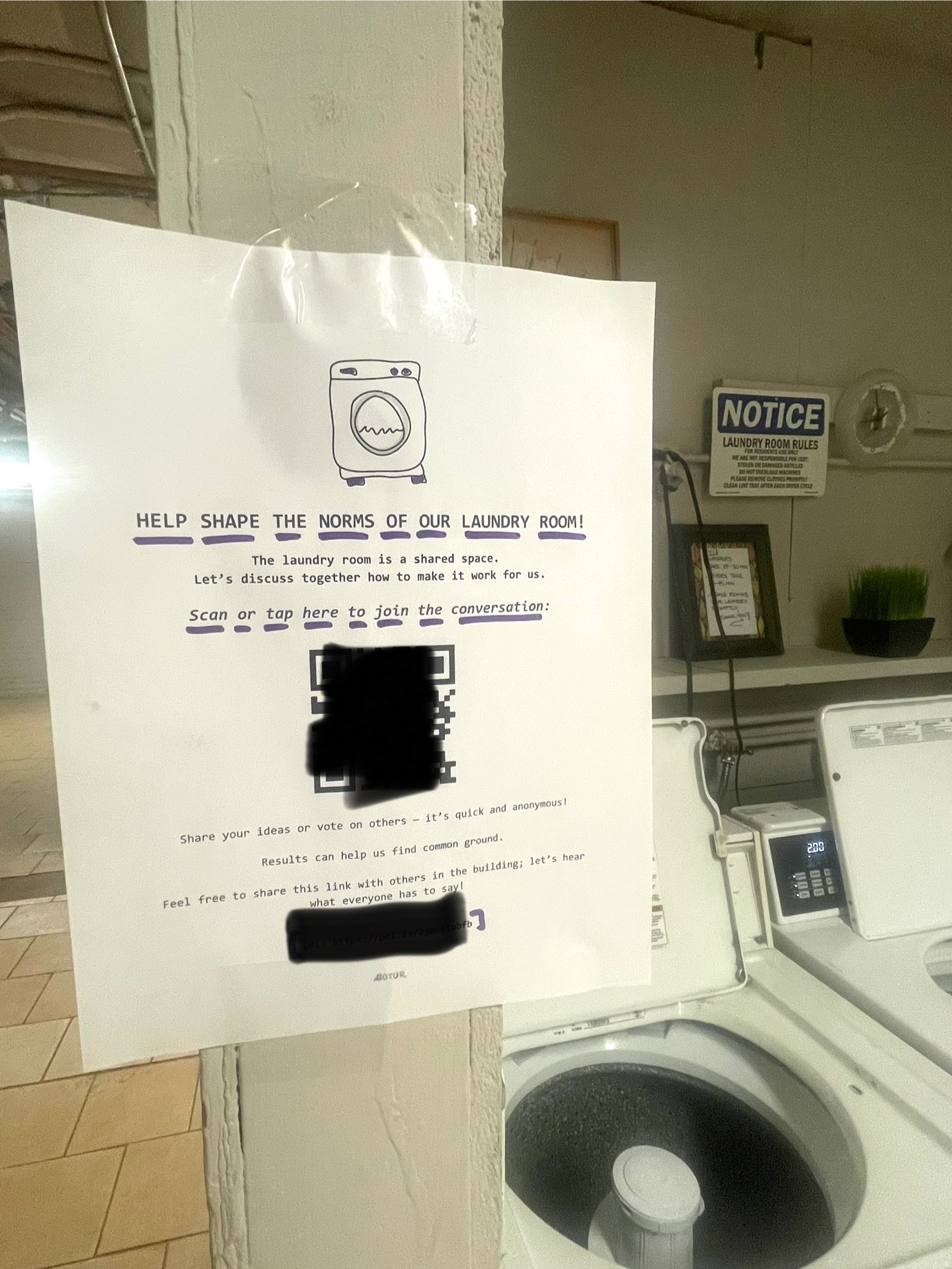
The choice about how to invite people to the conversation was also relatively straightforward. Since it was a conversation about the laundry room, I drew up and posted a simple flyer in the laundry room with a QR code and link to join the Polis conversation. Here is a pic of the flyer after it was posted (I drew the laundry machine clip art “by hand” on my computer for a personal touch):
I wasn’t too sure if anyone would be interested to engage in the conversation, but the effort involved in setting it up was so minimal–maybe an hour of work–that I figured it was worth a try. I planned to let the conversation run for a few weeks to give time for folks on different laundry schedules to participate, and waited. I was curious to see what would happen.
Synthesizing and Sharing Results
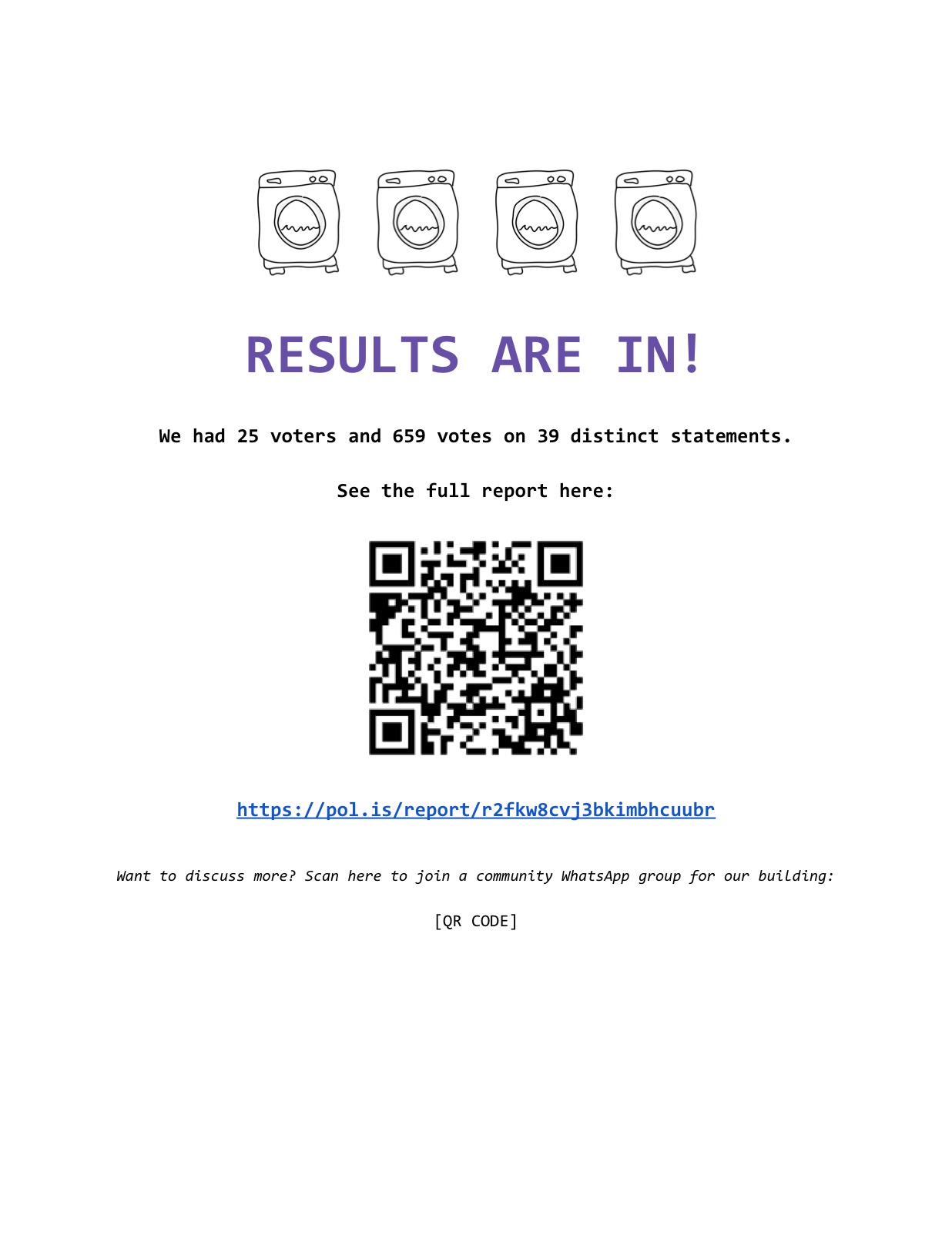
In the end, I was pleasantly surprised with the level of engagement from folks in the building. According to the final Polis report, there were 25 participants in the conversation who cast a total of 659 votes on different statements. In addition to voting on the seed statements, participants added a handful of their own statements for others to vote on.
I decided a reasonable next step was to simply share back the results with the community so that everyone could see what everyone else thought. After all, the initial goal was to clarify the shared norms of the space.
To this end, I generated a polis report and created a new flyer linking folks to it. Here is what the main results flyer looked like:
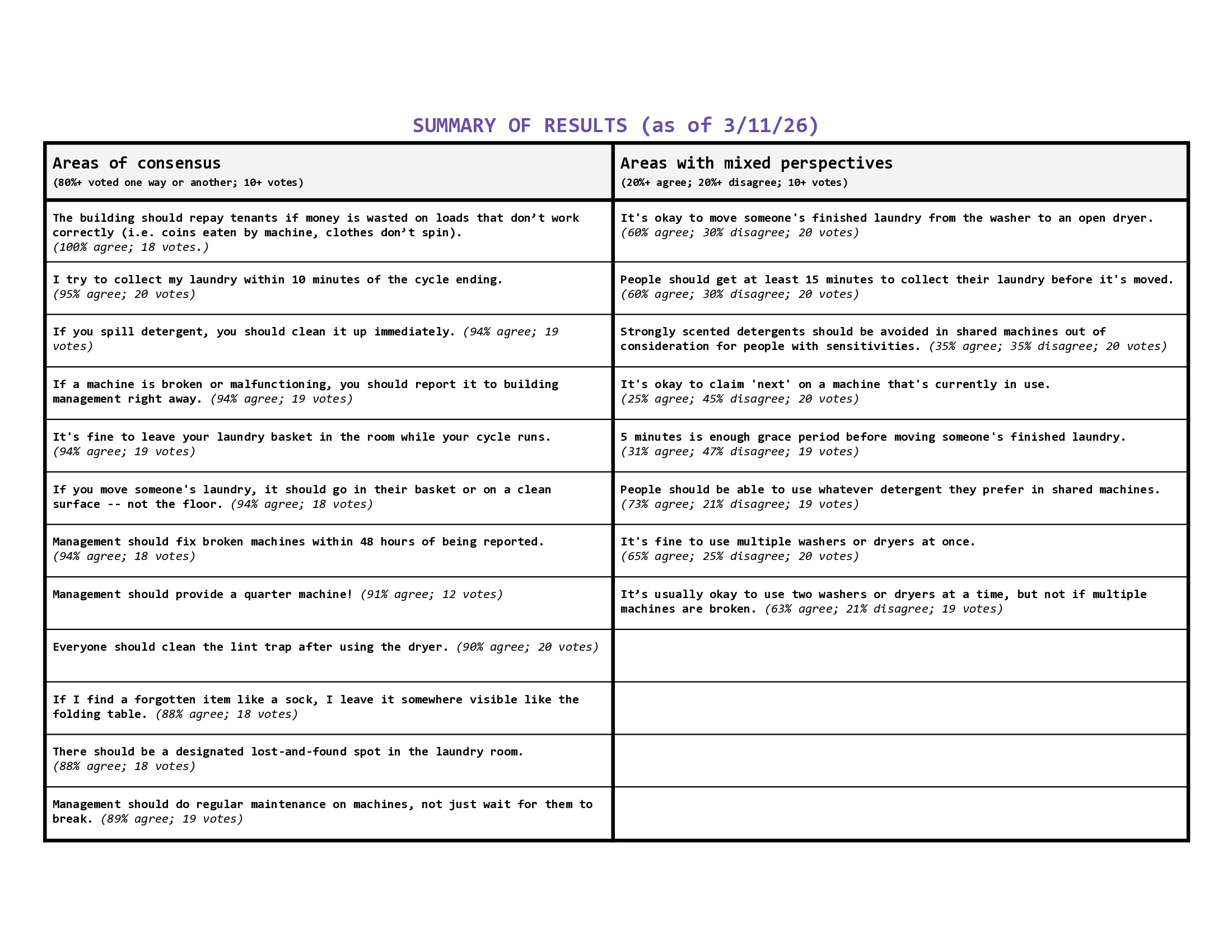
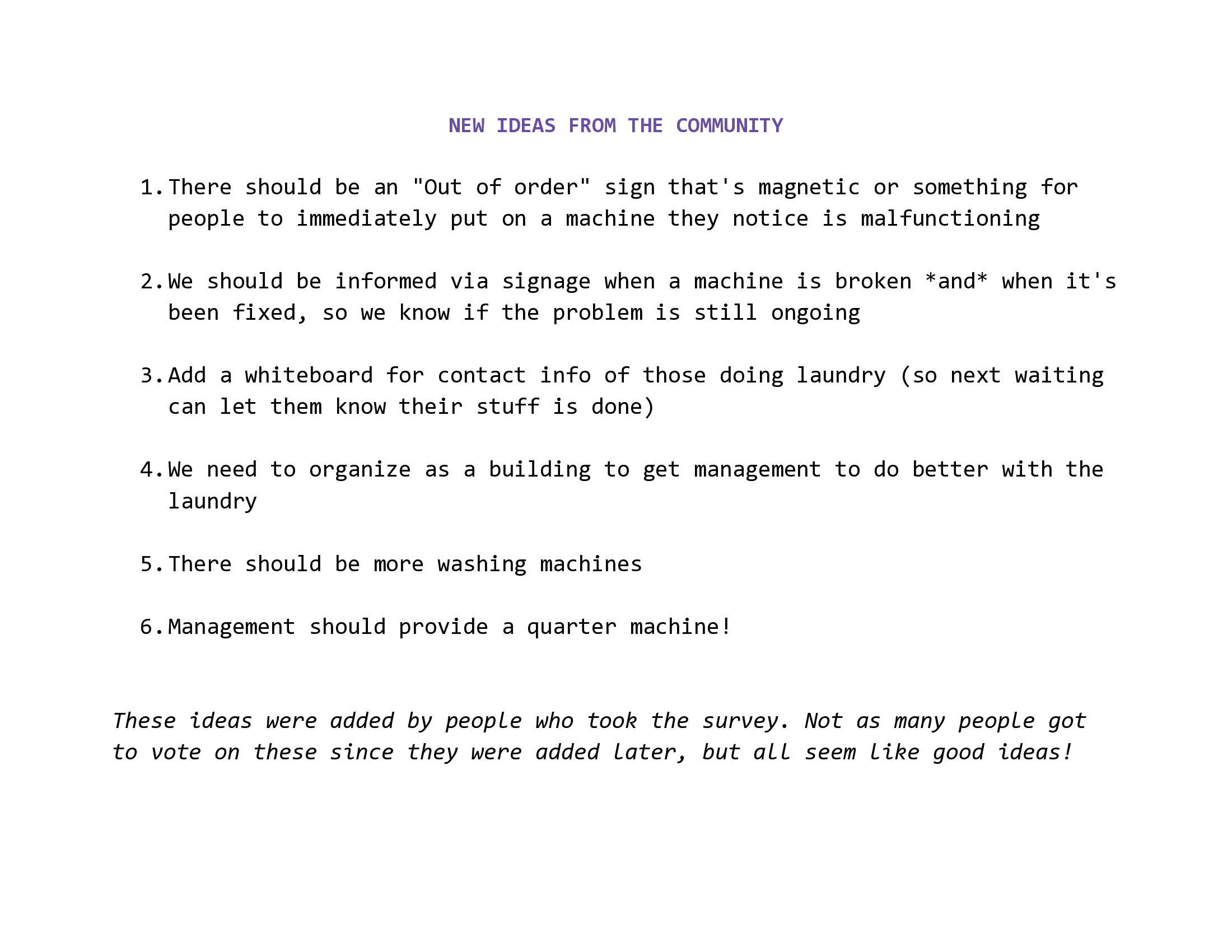
I also did a bit of my own summary of the results, since there’s a lot going on in the raw Polis report. In my summary, I tried to clearly separate the statements where there was broad consensus (i.e. the agreed-upon norms) from those where there were more varied perspectives. I also split out some of the helpful suggestions that people in the community had made. Here’s what that part looked like:
I printed things out and posted it all in the same spot as my previous flyer:
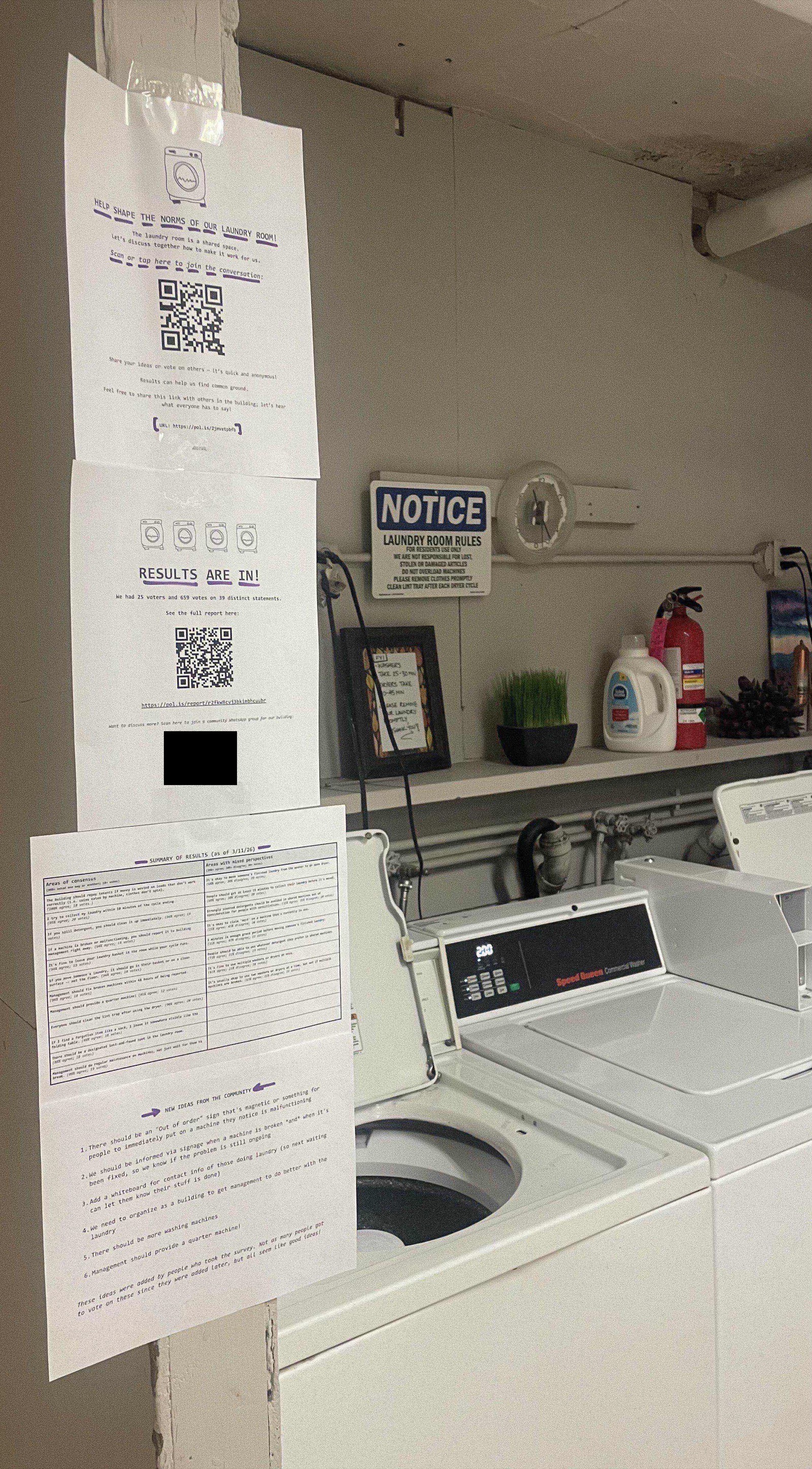
One perhaps unsurprising result from the Polis conversation was that there was broad agreement among tenants about all the statements that suggested that building management should do more to maintain or improve the laundry room space (add more machines, add a coin machine, reimburse tenants for issues etc.). People also generally agreed about standard norms like clearing the lint trap after using a dryer, or cleaning up spills. However, there was also more disagreement about some of the topics noted above – e.g. when/whether it’s okay to move someone’s laundry over to the dryer, or whether it’s okay to claim “next” on a machine.
I was also very interested in the new suggestions that participants offered. Some of these – like the whiteboard and the magnetic “out of order” sign – seemed both clever and easy to implement. So I decided to give them a go.
For a total of maybe $20 at Michaels, I was able to pick up a basic whiteboard, and a few magnetic picture frames, which I filled with “Out of Order” signs. I hung everything up in the laundry room and again waited to see if folks would engage:
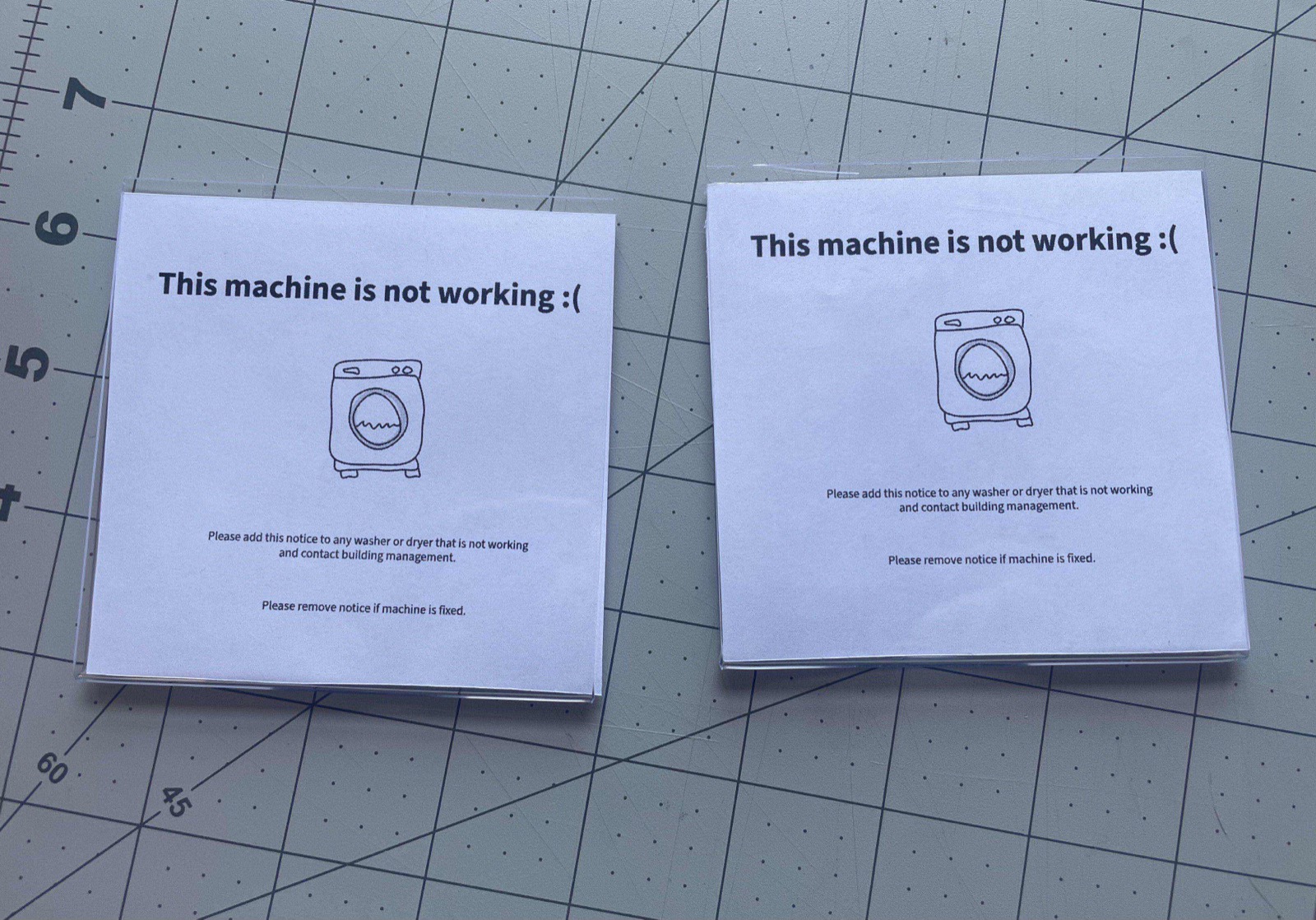
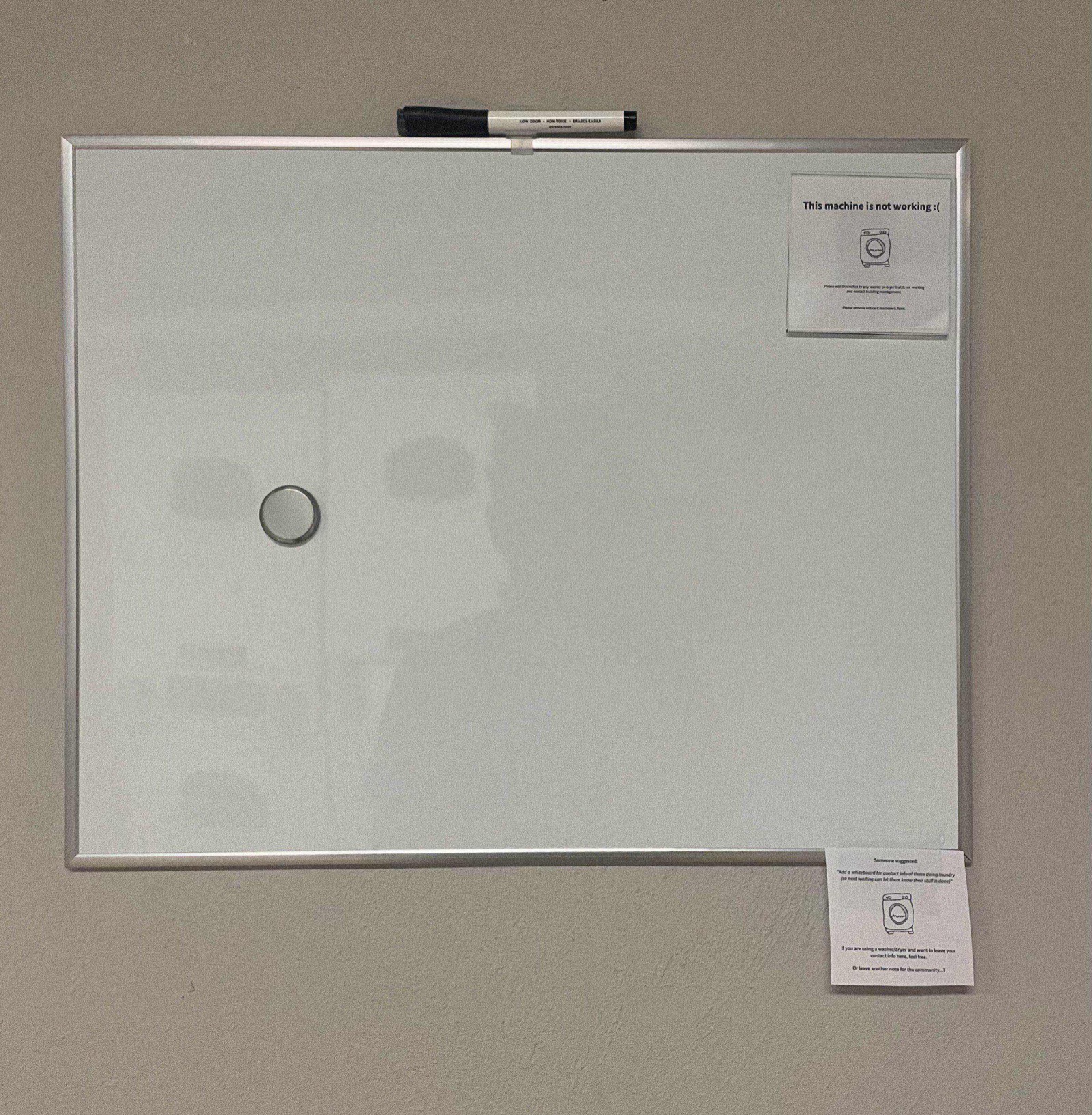
I didn’t have to wait long. Straight away, folks started writing notes on the community whiteboard. Here is a pic of the board a few days later:
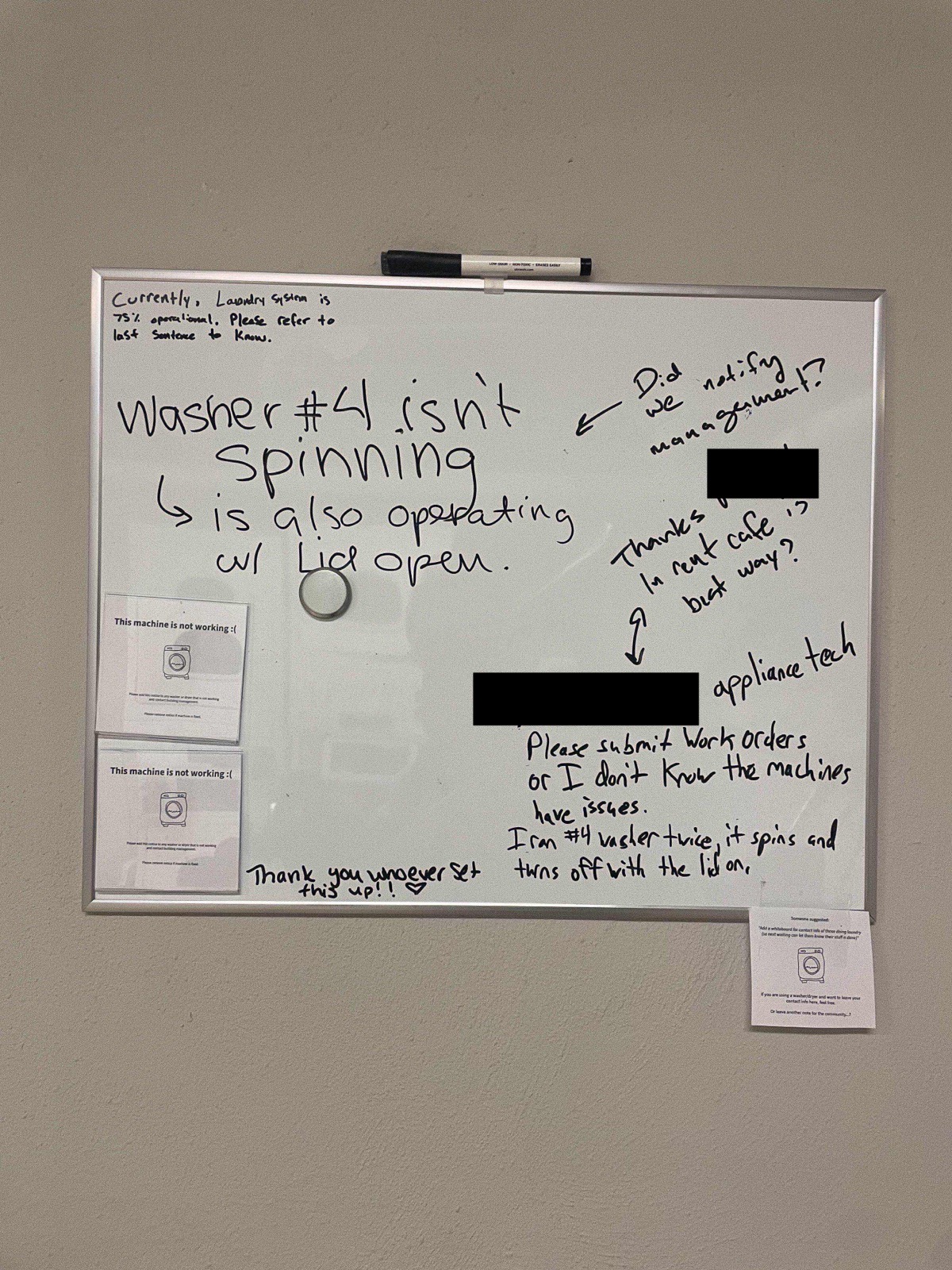
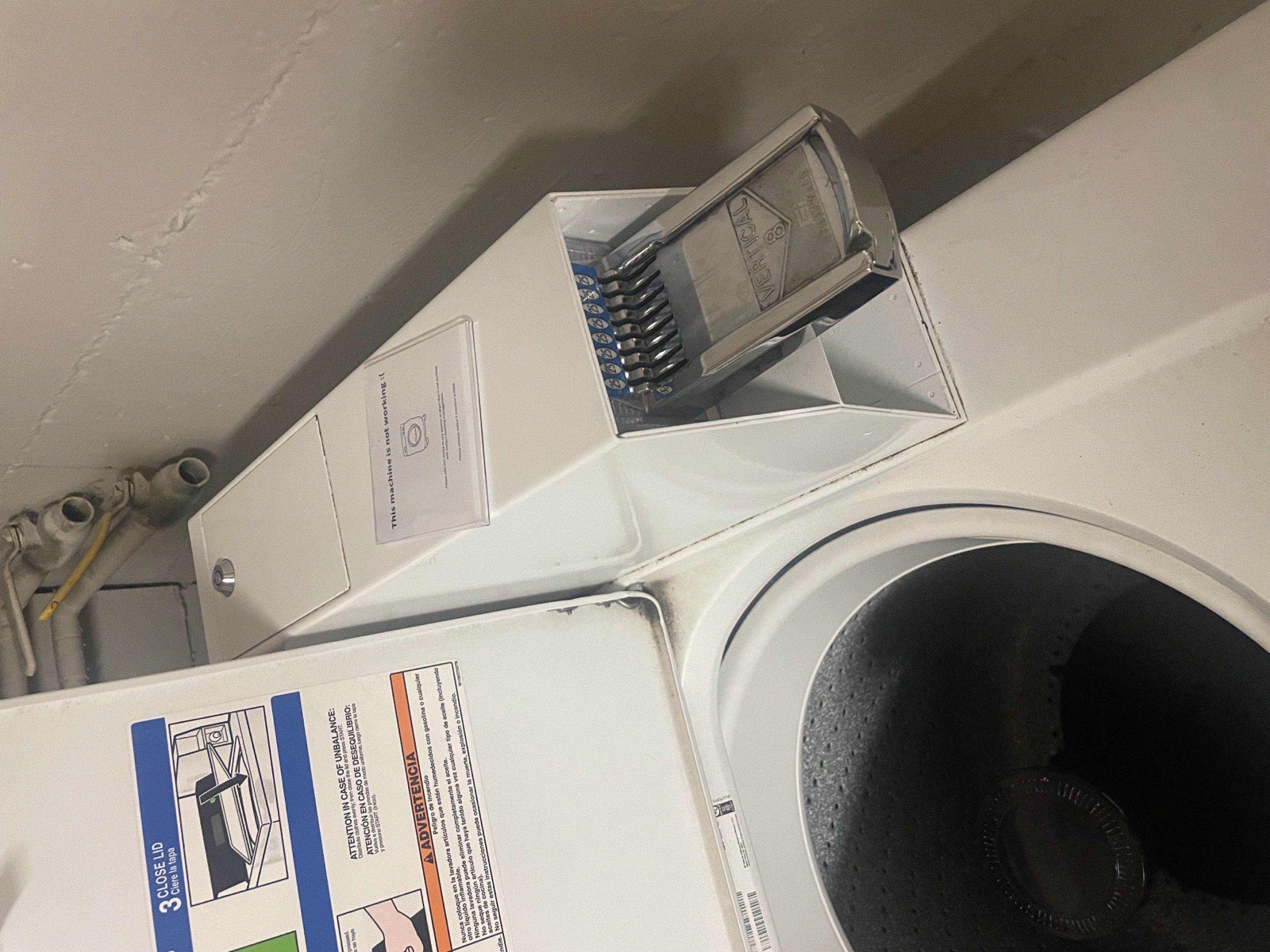
The blacked out bits includes the name of the building’s appliance tech who also wrote on the board. Likewise, here is someone using one of the magnetic “Out of Order” signs:
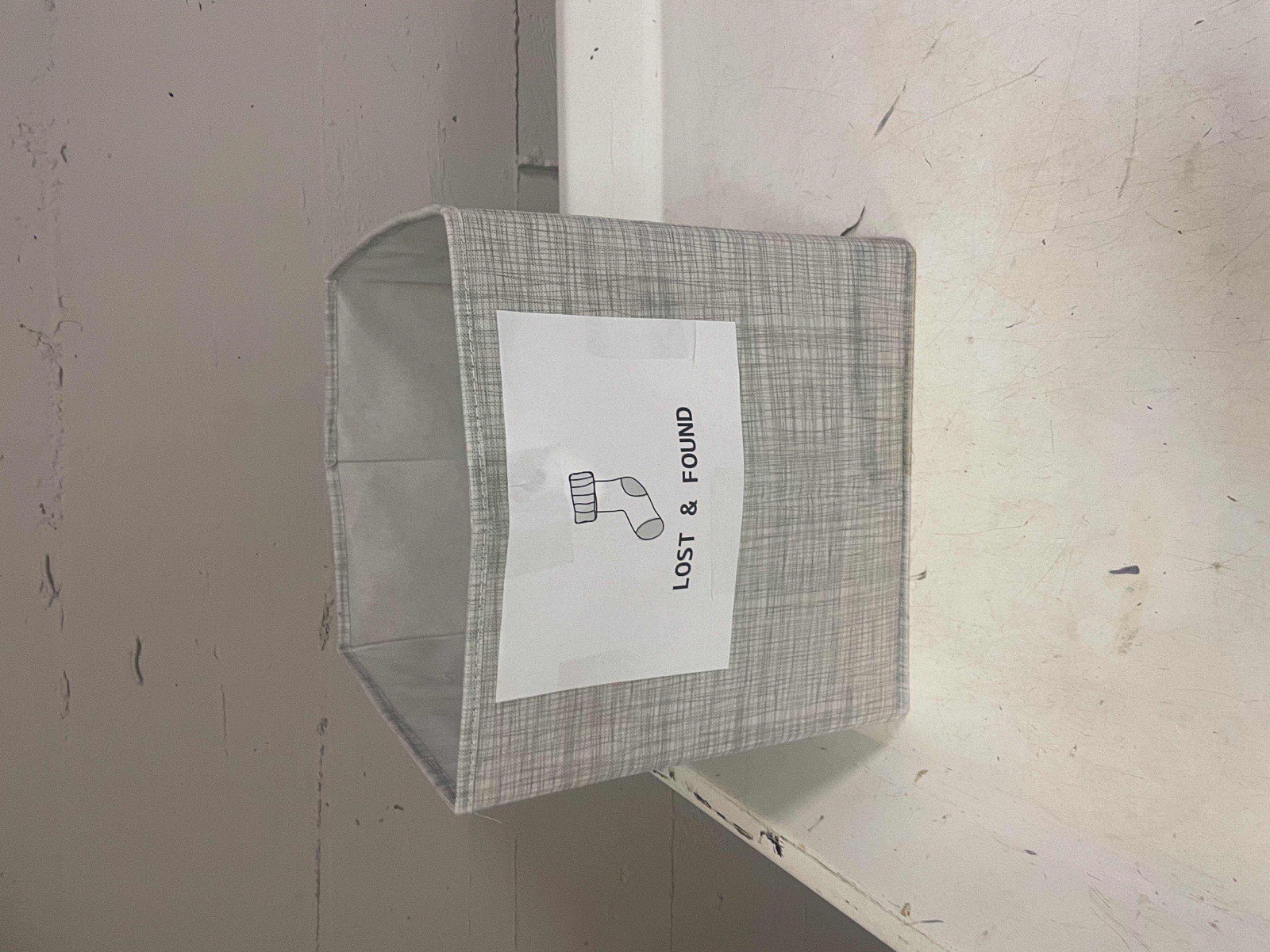
I also appropriated a bin that someone had left behind to become the new “Lost and Found”, which was quickly put to at least modest use:
As time has gone on, people have used the whiteboard in different ways, both for productive and fun uses. Someone began a game of anonymous tic tac toe in the corner of the board. Someone drew a picture. Someone made a note that they’d submitted a work report about ants in the building.
Interestingly, I haven’t seen anyone post contact info just yet (to be texted when laundry is done), as suggested by the original commenter. But still it seems to have been a helpful community space, and I am curious to see what else will evolve.
Next Steps and Takeaways
I am not sure what will happen next with this experiment in laundry room governance. Perhaps we tenants should join together to share some set of requests to building management; maybe we could encourage them to add a coin machine, or be more proactive about maintaining the laundry machines.
However, running this experiment has raised a few key questions and takeaways for me.
My first takeaway has to do with the value of providing “containers” for public participation. As documented above, I was happily surprised by the willingness of my fellow laundry room users to engage on the Polis conversation once it was established; there were a variety of good ideas about how to make the space work better, many of which were ultimately quite easy to implement (e.g. the whiteboard, the lost and found). However, prior to the Polis conversation, these ideas and perspectives were “latent”, un-realized. To make them real, all that was required was a tiny bit of investment to create a “container” for folks to engage and share thoughts.
To me, this seems like a nice way to approach organizing more broadly: how might I provide the right “containers” for people in my community to come together, discuss, identify, and hopefully solve their shared problems?
Of course, this perspective also raises deeper questions about when and why people feel a sense of agency and responsibility over the spaces and communities that they inhabit. When I am a member of a public or a user of a public space, when do I think of myself as “agentic” or “responsible” for that public’s upkeep or well-being? When do I feel able to take actions to improve it? And why? And if I do not feel agentic or responsible, why not? Is it that I am just not thinking about it? Do I feel like I need “permission” from someone? Do I assume that it is someone else’s responsibility? Does it seem like too much work?
This brings me to my second takeaway about the role of deliberative technologies like Polis in all of this. Much of the discourse about tools like Polis has emphasized their ability to support public deliberation at huge, even country-level scales. For example, Polis has been used as part of an initiative called vTaiwan where, according to the website, it “has been pivotal in achieving ‘rough consensus’ on various policy issues at the national level, addressing scalability challenges in deliberative democracy.”
While scale may be a useful goal, deliberative technologies like Polis also make it easier to set up and facilitate a (kind of) decentralized deliberative conversation in the first place. In other words, Polis makes it easy to create a basic “container” for public conversation–it’s free, open source, publicly available, and relatively easy to use. Given this, I am curious if we might see deliberative technologies facilitate more “scaling down” as well as “scaling up” – making it feasible to have deliberative conversations in ever smaller-scale settings like the apartment laundry room, where it might otherwise be too difficult to set something up.
Approached in this way, deliberative technologies might help us see ourselves as participants (and agents!) in a richer, more granular, and dynamic set of publics and communities.
Try it For Yourself?
If you want to facilitate a deliberative conversation in your own laundry room (or in another community), you can start a Polis conversation here. Sign in and click “Create a new conversation”. Here are the configuration settings that I used:
- Topic: Laundry Room Community Guidelines
- Description: Help shape the shared norms for our building’s laundry room! You can participate in two ways: (1) vote on statements you agree or disagree with, or (2) add your own statements for others to vote on.
- Seed Statements: Here is the complete list of seed statements that I used (also available as a CSV download for easy import into your own Polis conversation):
Expand to see full list of seed statements
Finally, I’ve uploaded all my flyers and assets to a public Google drive folder here. Feel free to modify or reuse as you see fit.